
This is precisely how Geri di Gavinana, born Giuseppe Geri, described his native town in his verses, giving us a genuine portrait of Gavinana and the Pistoia Mountains in the years between the two world wars.
These are ancient words from the poet “of little things”—as he liked to call himself—but they have not lost their charm and still resonate in the ears of those who, like us, find themselves passing through the village today.
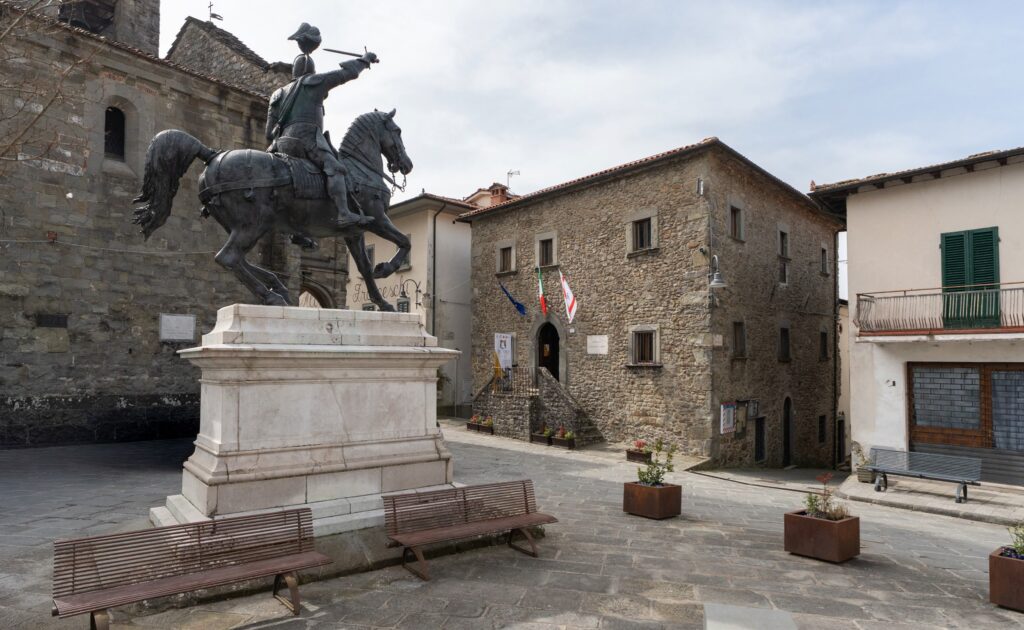
Gavinana, currently part of the Municipality of San Marcello Piteglio, is one of the oldest and most significant towns in the Pistoia Mountains, having been at the center of historical events of considerable interest over the centuries. Situated approximately 820 meters above sea level, at the foot of Mount Crocicchio, the town of Gavinana is surrounded by a ring of woods and chestnut groves: here, the stones of the houses, the parish church, and all the buildings overlooking the central square interact with the surrounding nature in a highly evocative landscape that characterizes and makes the Pistoia Mountains unique. A place where history, tradition, cultural identity, and nature coexist, at a slow and steady pace.
The village—despite its historical vicissitudes—still retains the distinctive urban layout of fortified villages, with a central square, a parish church, and, surrounding them, a maze of narrow, barely navigable alleys: ideal for making any potential incursions from the outside difficult, and for making Gavinana not just a residential center but also a secure and impregnable stronghold.
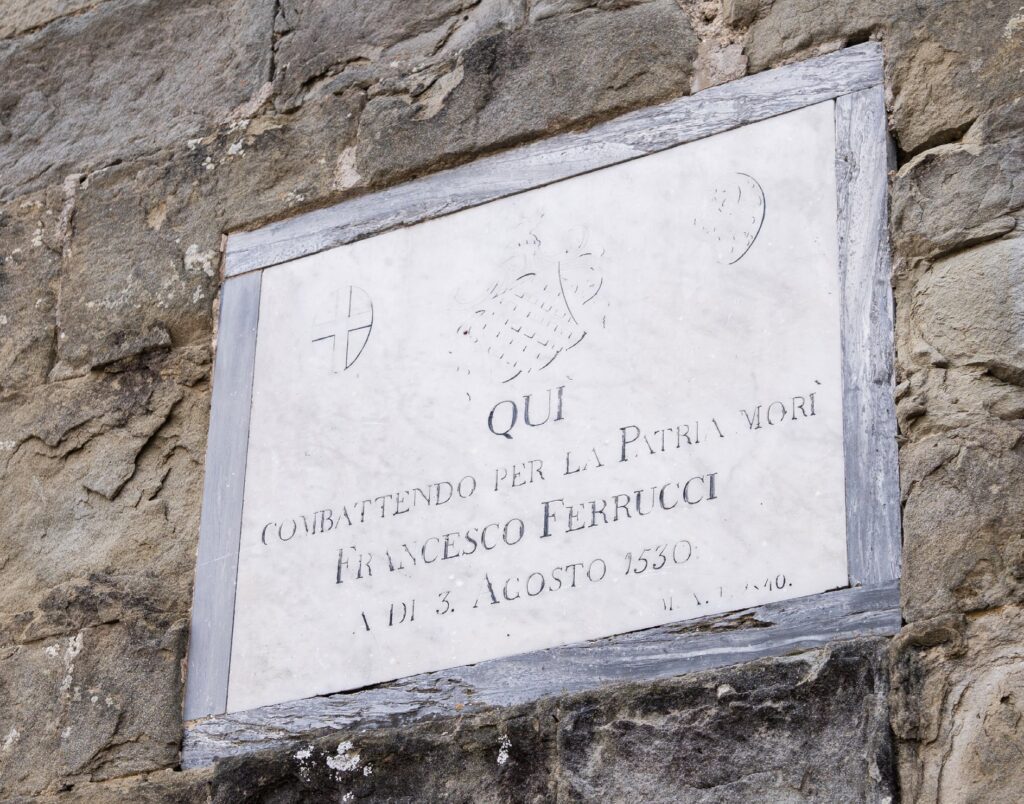
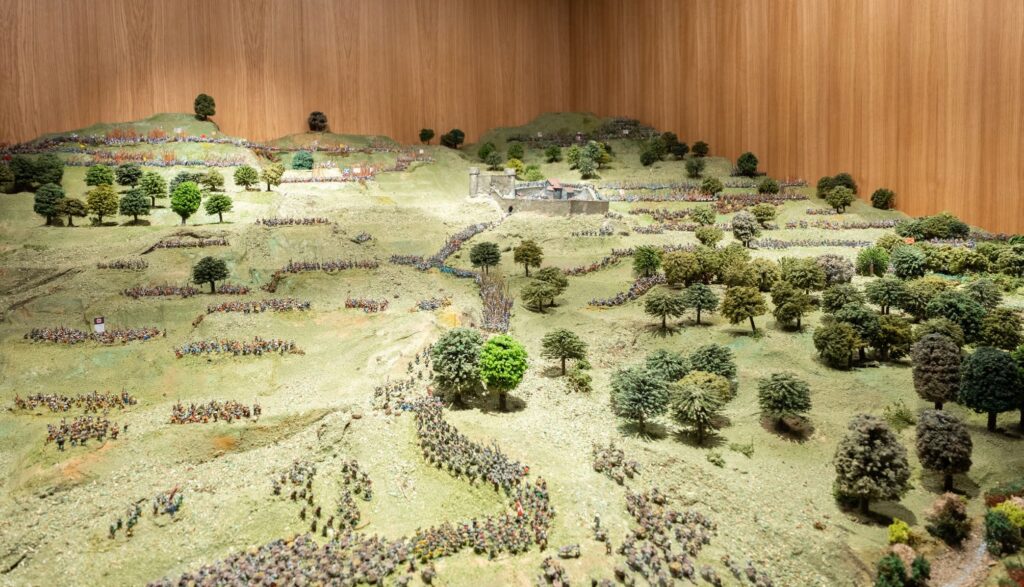
This was not the case, however, during the Battle of Gavinana on 3 August 1530, which saw the troops of the Florentine Republic led by Francesco Ferrucci face off against the imperial troops of Charles V led by Fabrizio Maramaldo. A decisive battle in the geopolitical chessboard of the time, which definitively put an end to republican power in Florence, decreeing the return of the Medici and their lordship. A battle as important as it was bloody and invasive, which ravaged Gavinana and definitively annihilated the brave leader Francesco Ferrucci. On these occasions, history is often intertwined with legend, and a famous moment is when Ferrucci, now at the end of his strength, railed against his opponent Maramaldo: “Coward, you are giving to a dead man!”, calling him a vile and cruel man. It’s no coincidence that the word “maramaldo” still refers to a person who takes advantage of the weak, just like the imperial leader.
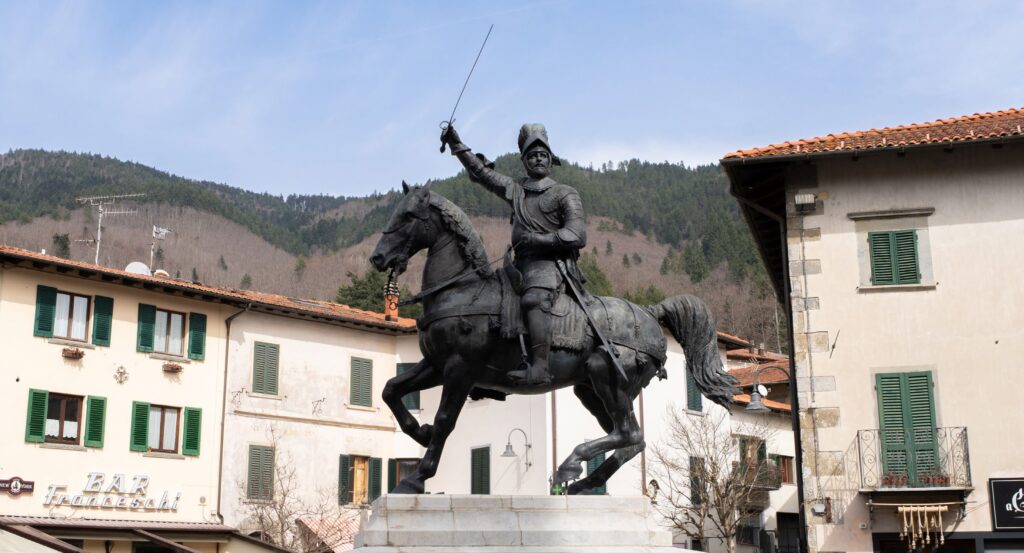
Francesco Ferrucci, considered a symbol and main protagonist in the history of Gavinana, stands out in the center of the square of the same name, a bronze equestrian monument created between 1912 and 1913 by the Sienese sculptor Emilio Gallori and inaugurated with great fanfare in August 1920, after the forced hiatus imposed by the First World War. Portrayed in sixteenth-century armor, with a proud and bold gaze, Francesco Ferrucci greets us from above and seems to watch over us, showing us the path to the freedom he so desperately hoped for and paid for with his life.
The equestrian monument is not the only memorial dedicated to Ferrucci, because in a town like Gavinana that built its fortune and popularity on his figure, tributes to the courageous man of fortune abound. However, it takes a careful and trained eye to catch the details because, often, important things are hidden in the most unexpected places.
This is the case, for example, of the plaque made in 1840 by Massimo D’Azeglio and placed on the side of the parish church of Santa Maria Assunta. It would certainly go unnoticed if it weren’t for the fact that that commemorative plaque represented the first-ever tribute to Ferrucci, in an era—that of the post-Napoleonic Restoration—when the Ferrucci myth exploded and the need arose to cultivate the memory of a hero who had embodied the values of freedom and independence that would later form the basis of the Risorgimento and lead to the unification of Italy.
The memory of Francesco Ferrucci, thanks to history and the many tributes paid to him, has remained alive over time and is still part of Gavinana’s tangible and intangible heritage.
Visiting this village in the Pistoia Mountains is truly a journey through history, making it inevitable to encounter this legendary figure, to whom our own Geri di Gavinana also paid his personal tribute in the collection Fiori di bosco—the only one he published during his lifetime, in 1929: The Parish Church of Santa Maria Assunta. In a small village like Gavinana, one would not expect to find a parish church so majestic in its importance and size, which defines the urban space and establishes itself as the fulcrum of the entire town; the point around which everything has developed over time.
The parish church, a point of reference for the entire surrounding area, appears mentioned for the first time in a papal bull of Pope Innocent II in 1133.
The original building, especially the interior, underwent significant modernization in late Baroque style during the eighteenth century, but its Romanesque appearance can still be appreciated on the façade. The parish church’s distinctive feature is its imposing square bell tower crowned by a dome on an octagonal base: as is customary, it is the tallest building in Gavinana and characterizes the village’s skyline even from a long distance, making it unmistakable.
The parish church of Santa Maria Assunta houses a large pipe organ built by Pietro Agati – a well-known family of Pistoia organ builders – in 1776. Located on the counterfaçade, the organ of the parish church of Gavinana comes from the former convent of San Lorenzo and seals the connection with Pistoia and the local organ-building tradition.
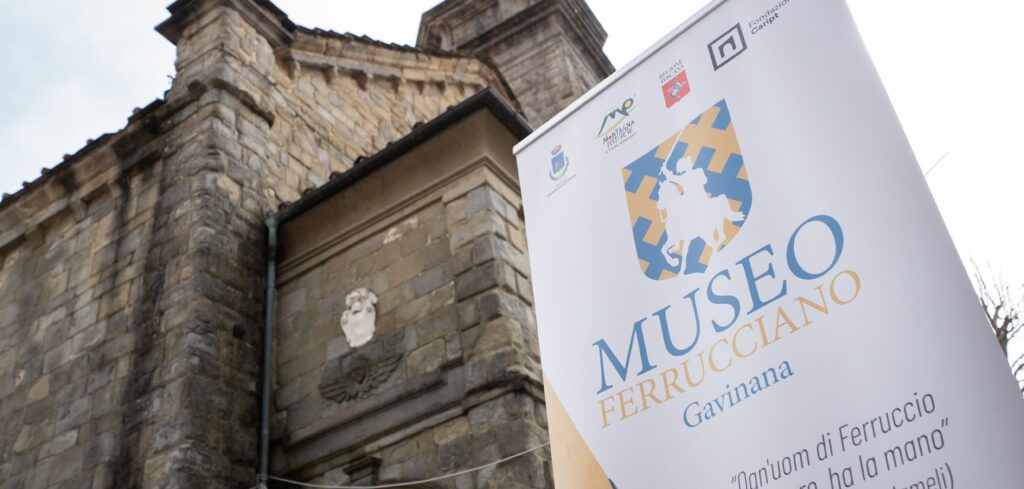
The renovated Ferrucciano Museum The museum dedicated to Francesco Ferrucci reopened to the public in November 2025, after an eight-year closure.
Officially founded in 1931, the Ferrucciano Museum has undergone alternating and unfortunate events that have prevented it from continuing to open over time. Today, it is finally accessible again with a new
and interesting display that fully showcases the museum’s heritage.
Throughout the rooms, one relives not only the story of Francesco Ferrucci but also the history of Italy: the museum tour thus allows one to understand the close dialogue that persists between Gavinana, the Pistoia area, and the national context of the time, with constant references to the historical episodes linked to the Battle, recounted through films, relics, and original weapons of the period. An exhibition accessible to all, with a markedly informative focus, which enables every visitor to gain a thorough understanding of the history of Gavinana and its importance.
Text by Clara Begliomini – Oltre Pistoia Tour
Photos by Lorenzo Marianeschi – Pistoia Mountain Ecomuseum Archive